# Overview
The team that brought you Splinterlands - one of the world's top blockchain-based play2earn games - is extremely excited to announce our next major project in the play2earn gaming space: Genesis League Sports (GLS)!
\
Splinterlands technology is uniquely positioned in the blockchain world to handle millions of users and hundreds of millions of transactions per day, making Splinterlands the perfect platform to bridge sports brands, athletes, and fans into the blockchain world. GLS will be a blockchain-based, play2earn gaming platform and ecosystem specifically designed for sports-related games and NFTs. It will host an ever-growing catalog of games across a plethora of sports types, as well as partnerships with major sports leagues and organizations around the globe.
Players will have the opportunity to own Non-Fungible Tokens (NFTs) of many of their favorite real-life athletes, stadiums, fans, power-ups, teams, formations, and more. They will be able to trade, train, boost, and group these NFTs into teams to compete against other players in various game modes and win cryptocurrency, NFTs, and other prizes!
\
GLS aims to create a decentralized gaming ecosystem that allows true player ownership of digital assets in addition to a Decentralized Autonomous Organization (DAO) that will give players governance control over many aspects of the platform. As a result, GLS will provide a secure and user-friendly blockchain experience for gamers and sports fans.
We are also extremely excited to announce that the first game within the Genesis League Sports platform will be **Genesis League Goals, which will be launched in partnership with the Major League Soccer Players Association (MLSPA)**! Players will collect, buy, rent, sell, and compete with their favorite, real-life MLSPA players while earning cryptocurrency and other rewards! For more details about the Genesis League Goals game and NFTs, please stay tuned for a whitepaper specifically focused on that game which will be available shortly.
# Tokenomics
This section will discuss the tokenomics of the Genesis League Sports Ecosystem.
Users will utilize three types of cryptocurrency tokens on The Genesis League Sports Platform.
* Genesis League Governance Token (GLX)
* GLX is a governance token that enables users to participate in the GLS ecosystem. Users with staked GLX will have a say in how the overall game and ecosystem work.
* Genesis League Stable Token (GLUSD)
* GLUSD is a stablecoin accepted in-game at a rate of 1 GLUSD = 1 U.S. Dollar. Players can use this token to buy packs, rent cards, and purchase other in-game products.
* Genesis League Game Time (GLGT)
* GLGT is a token representing “time staked” and will be awarded to players who stake GLX tokens or hold validator node licenses over time. It will be used to get discounts on products and exclusive/early access to promotions.
# Genesis League Governance (GLX) Token
The Genesis League Governance (GLX) Token will be the staking, reward, and governance token for the entire Genesis League Sports (GLS) ecosystem. All games that are part of the GLS ecosystem will allow players to earn GLX tokens and will be governed by a Decentralized Autonomous Organization (DAO) owned and controlled by players who stake GLX tokens. While the initial plan for GLS is below, over time, users will be able to create proposals to change specific games, features, and the overall ecosystem.
### Utility
The GLX token will have three primary uses within the GLS ecosystem:
* Earning staking rewards
* Participating in platform governance
* Minting new Genesis League USD Stablecoin (GLUSD) tokens through burning
### Distribution
Maximum Supply: 2,000,000,000 GLX
GLX tokens will be issued/unlocked in a pre-determined schedule that lasts approximately 65 months from the date the token is first released.
| Category | Total Tokens | Release Schedule |
| ------------------------------------- | --------------------------------------------------------------------------- | ------------------------------------------------ |
| Staking Rewards | 100,000,000 | 12 Months |
| Airdrop | 100,000,000 | 12 Months |
| Liquidity Provider Rewards | 100,000,000 | 65 Months |
| Validator Rewards | 100,000,000 | 65 Months |
| Decentralized Autonomous Organization | 100,000,000 (half on day 1) | 65 Months |
| GLG Play to Earn (P2E) Rewards | 100,000,000 | 65 Months |
| Future Partnerships |
1,400,000,000
(up to 100M per partnership decided by team/DAO)
|
65 Months
(from partnership launch)
|
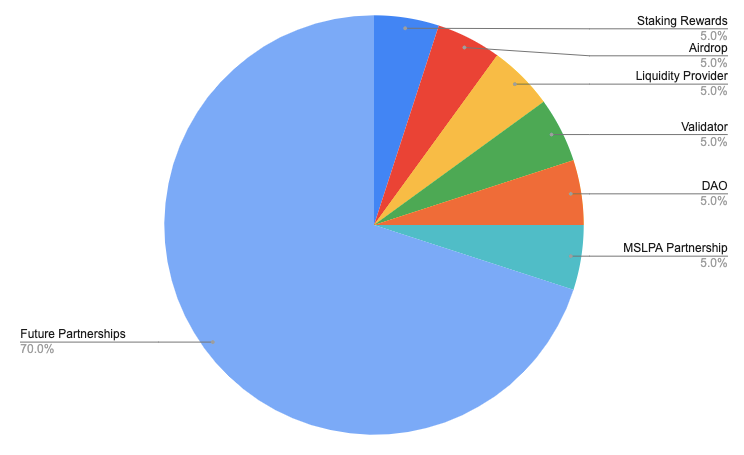
The following graph shows the complete token allocation of GLX.
Complete Token Allocation
### Staking Rewards
To earn GLX staking rewards, participate in governance, or participate in special offers, promotions, and bonuses available in the various partnerships, users must have staked GLX tokens in their accounts.
Staked GLX tokens are not liquid and may not be transferred or sold. Therefore, if a user wants to sell or transfer their GLX tokens, they must go through an unstaking process. Unstaking will be a four-week process, with 25% of the total amount of tokens released into the liquid supply each week.
For example, if a user unstakes 100 GLX, at the end of the 7th day, 25 GLX tokens will be available in liquid form in the user's account. These liquid tokens can then be sold, transferred, or restaked.
We plan to reward 100,000,000 GLX tokens to GLX stakeholders during the first year. The staking rewards will last 12 months, with approximately 274,000 GLX tokens awarded daily to GLX stakeholders.
GLX stakeholders will receive daily rewards based on the amount of staked GLX in their account as a percentage of the total staked GLX in the whole system. *After the first year, the staking rewards will be moved and built into future GLS games. Staking will become an integral part of each game, and users will be able to stake their GLX tokens to maximize in-game rewards and gain access to special features of the game. (more on this in the P2E Rewards Section).*
### Airdrop for SPS Stakeholders
GLS will airdrop 100,000,000 GLX tokens to Splinterlands SPS stakeholders for the first 12 months. The distribution of the GLX airdrop will be determined by a daily snapshot of all the staked SPS holdings over the year. During that time, approximately 274,000 GLX tokens are expected to be airdropped to SPS stakeholders daily.
The amount of GLX tokens each user will receive for the daily airdrop will be based on the amount of staked SPS in their account as a percentage of the total staked SPS in the whole system. So, for example, if there is a total of 100M staked SPS, and a particular account has 1M SPS staked, then they will receive 1% of the daily airdrop or roughly 2,740 GLX per day.
### Liquidity Provider Rewards
GLS has set aside 100,000,000 GLX tokens for liquidity provider rewards. These rewards will be distributed to users who support the health of our token economies by providing liquidity for the GLX token against other frequently used tokens. The first planned liquidity pools will include the following:
* GLX/HIVE
* GLX/Binance Coin (BNB)
* GLX/Ether (ETH)
Initially, each of the three trading pairs will receive 20M GLX rewards distributed over 65 months. This means an extra 40M GLX tokens will be set aside for the possibility of adding future trading pairs.
In the future, the DAO can vote to add new trading pairs or change the amount of rewards to any trading pair. The idea is that the DAO can vote on how the 100M is distributed among the different trading pairs based on market demand.
The amount of the daily rewards that each user will receive for each pair will be based on the amount of liquidity provided as a percentage of the total liquidity for that particular pair.
In the future, the DAO will be able to vote and;
* Change the percentage of rewards assigned to each pair.
* Create liquidity for new pairs.
* Increase the number of pairs supported.
### Decentralized Autonomous Organization
GLS will add 100M GLX tokens to a foundation which will be controlled exclusively by the GLS DAO. The GLX distribution into the DAO fund will last for 65 months. On day one, the DAO will receive half of the airdrop, 50M GLX. For the following 64 months, the DAO will receive approximately 781,250 GLX tokens monthly, unlocked on the first of every month.
### Validator Rewards
Over the first 65 months, GLS will distribute 100,000,000 GLX tokens to the validators supporting the GLS ecosystem. That means approximately 51,280 GLX tokens will be rewarded daily to GLS validator license holders.
For more information about Validators, please check the Delegated Proof of Stake and Validator Nodes section.
### Play2Earn (P2E) Rewards
* Each game will have its own set of P2E Rewards.
* The MLSPA is the first partner of the GLS platform.
* 100M GLX tokens will be allocated to the P2E rewards for the Genesis League Goals: MLSPA Edition Game.
* The 100M GLX will be unlocked over 65 months.
* 1,400,000,000 GLX tokens will be set aside as P2E rewards for prospective partnerships.
* In the future, the GLS Team will propose an initial supply for each partnership based on various parameters, such as the size of the partnerships and market conditions.
### Future Partnerships
* GLS aims to build an ecosystem of various sports games and entities on our platform.
* 1,400,000,000 GLX tokens will be set aside as P2E rewards for prospective partnerships.
* In the future, the GLS Team will propose an initial supply for each partnership based on various parameters, such as the size of the partnerships and market conditions.
* The GLX stakeholders will vote on this proposal to make sure DAO members agree with the assigned P2E rewards for each partnership.
* Since the DAO votes on the amount of rewards per partnership
* If all future partnerships get 100M GLX as P2E rewards, then the max number of partnerships is 14.
* If all future partnerships get 50M GLX as P2E rewards on average, then the maximum number of partnerships is 28.
For more information about how the P2E rewards are distributed to players of each partnership, please visit the P2E Rewards Section.
# Genesis League USD Stablecoin (GLUSD) Token
The Genesis League USD Stablecoin (GLUSD) token is a cryptocurrency token intended to maintain a relatively stable exchange rate with the US dollar. We feel that having a native token with a relatively stable value in relation to the US dollar within the Genesis League Sports ecosystem will be a vital part of the stated goal of the platform to create a user-friendly experience for all players.
Via GLUSD, players will be able to hold and transact in a token that has a familiar and relatively stable value all over the world. This will make most monetary in-game transactions, such as buying or selling NFTs on the peer-to-peer marketplace, much easier and more convenient. The players will not have to deal with rapidly changing third-party market prices and conversion rates for their payment tokens.
## Utility
The GLUSD token will have several primary uses within the GLS ecosystem:
* Buy and sell packs starting with Genesis League Goals
* Buy, sell, and rent NFTs on the Genesis League Sports Marketplace
* Pay for in-game items and transactions
## Stability
The GLUSD token will attempt to maintain a stable exchange rate of 1 GLUSD per 1 USD via two relatively simple mechanisms.
### Creating GLUSD from GLX
Players will, at any time, be able to burn $1 worth of GLX tokens for one GLUSD token. The top-voted validators in the DPoS governance system will act as oracles and provide a price feed that will allow the system to determine the time-weighted average price of the GLX token on external markets for these conversions. Simply put, if the time-weighted average price of GLX is $0.50, users will need to burn two GLX tokens for one GLUSD token. *Please note that users will receive 97.5% of the value in GLUSD as a buffer to prevent potential price manipulation exploits.*
This mechanism will help ensure that the value of GLUSD tokens does not go much above the intended target of 1 USD on the various external markets due to the arbitrage opportunity it provides to token traders who would be able to burn $1 worth of GLX in exchange for greater than $1 worth of GLUSD tokens.
### Product Pricing in GLUSD
All products sold in the Genesis League Sports ecosystem will be available to be purchased with a fixed amount of GLUSD tokens at the rate of 1 GLUSD per 1 USD, regardless of what the exchange rate of GLUSD is on external exchanges. For example, if the external pricing of GLUSD is 1 GLUSD = $0.5 then the price of product in-game would be available at a discount.
Pricing products in GLUSD tokens will ensure that those tokens always have a specific value. As long as there is demand for the products being sold within GLS games, the GLUSD token will have value. Should the GLUSD ever be available at significantly below $1 on external markets, it will provide an arbitrage opportunity for players to purchase GLUSD on the external markets (pushing the price up).
For those familiar with the Splinterlands game, this mechanism is modeled after the Dark Energy Crystals token. We believe these two tokens will be the first examples of an exciting and innovative new type of stablecoin whose value is backed by actual products rather than other tokens/currencies or algorithms.
# Genesis League Game Time (GLGT) Token
The Genesis League Game Time (GLGT) Token will be awarded to players who stake GLX tokens or hold GLS validator node licenses over time as an additional reward avenue. These tokens represent “time staked” and give GLX stakers and license holders additional ways to capitalize on the value they are providing to the ecosystem.
GLGT tokens will be used to provide access to special promotions or events and to provide discounts on various products across the GLS ecosystem. For example, GLGT tokens may be spent to get a discount on NFT pack purchases, in-game items in the game shops, or various fees paid within the games. Additionally, nearly all special promotions and events that will be held within the different GLS games will require GLGT tokens to be spent to participate or offer significant discounts.
This mechanism aims to provide the players who stake GLX tokens and participate in the validator node system to get direct benefits within the games and exclusive/early access to promotions. Alternatively, players have the option to resell the tokens on third-party markets to other players who want the benefits/access but haven’t staked enough or for long enough to earn it themselves.
In either case, the value ultimately goes to the GLX token stakers and license holders and thereby provides additional incentives for both of those GLX token use cases.
# Hive Blockchain
The Genesis League Sports (GLS) platform, as well as all of the individual games that run on it, will be built as a second-layer solution on top of the Hive blockchain. Some may find that to be an unusual choice given the myriad of other blockchain platforms that are currently available, which boast much higher market caps for their tokens and command much more media attention; however, we believe that Hive is far and away the best choice in order to be able to achieve our stated goal of creating a decentralized platform that also provides a secure and user-friendly experience for all types of potential players for the reasons described below.
The Hive blockchain was created in March 2020 as a fork of the Steem blockchain. Dan Larimer originally created the concept and software, and it is now a completely community-owned chain with no pre-mine and a DAO to fund ongoing development and operation. For more information about the Hive blockchain, please see [https://hive.io](https://hive.io/).
### Scalability & Stability
Scalability and stability are essential for running any large, mainstream application, but they are often difficult to achieve in a decentralized blockchain platform. Many newer blockchain platforms boast incredibly high transaction throughput benchmarks, but few of them have proven this in practice.
When many of these platforms have started to be tested with real applications, there have been repeated instances of instability, downtime, and vulnerabilities that may take years to fully iron out.
In contrast, Splinterlands has been running on the Hive blockchain (and originally the Steem blockchain before the fork) for over four years. Players currently submit over three million daily transactions to the chain on average.
The Splinterlands team has already been through instability, downtime, vulnerabilities, and multiple market crashes while operating on the Hive blockchain. As a result, we feel that it is the most battle-tested, highly-scalable, decentralized blockchain platform available right now, which makes it the best choice to power our new projects.
### Fast & Free Transactions
The “gas fee” model employed by the vast majority of blockchain platforms is a non-starter for any mainstream blockchain-based application, in our opinion, and the Hive blockchain handles this very easily and elegantly with its implementation of Resource Credits.
Rather than paying cryptocurrency to submit a transaction, users on Hive are given Resource Credits (which you can think of as bandwidth) that are used to submit transactions based on the amount of HIVE tokens they have staked (or “powered up”) in their account. Additionally, Hive accounts can delegate their Resource Credits to other Hive accounts, which allows one account to basically pay for other accounts' transactions.
This way, rather than requiring users to acquire cryptocurrency and manage their Resource Credits themselves, applications that operate on the Hive blockchain can be the ones that receive the HIVE tokens and can manage the Resource Credits on behalf of all of their users via delegation.
### Wallets, Keys, & Security
By far, the most important and challenging piece of providing a user-friendly and secure experience for mainstream users on a blockchain-based application is handling wallets and private keys.
In order to maintain the true digital asset ownership at the heart of blockchain-based applications, users must hold their own keys and manage their own wallets rather than a centralized entity holding the keys and acting as a custodian of users' digital assets. That typically leads to a situation where users are completely responsible for the security of their assets and wallets, and if they lose their keys or their keys get compromised, then they will lose all of their assets and value they have invested into these projects and not even the company that created the application can help them to recover it.
We believe this is an entirely unworkable and unrealistic solution for the vast majority of users. The Hive blockchain is the only platform we have found to date that provides a reasonable solution for protecting users from the loss or theft of their keys while still maintaining decentralized player ownership of assets.
Unlike most other blockchain platforms, Hive wallets are not simply a public/private key pair. Users choose their own account name which is their public wallet address, and is similar to familiar web2 platforms like Twitter. Each wallet can have multiple varying public/private key pairs associated with them with different levels of permissions in the account, and those keys can be changed if any of them are ever compromised.
The Hive blockchain also includes a decentralized account recovery feature that allows an account owner to recover their account with the help of a chosen trusted third-party even in the event that all of their keys are compromised. Genesis League Sports games will require players to lock their assets before they are able to be used in the game, which means that before the assets can be transferred out of the account they must first be unlocked which will take a period of time.
This means that if a user’s account is compromised, the hacker can only start unlocking their assets and will not be able to transfer them out of the account immediately. When this happens, the original account owner will receive a notification that an unlock has begun on their account, which will alert them to the fact that their keys have been compromised. They can then work with their recovery account (which will be the Genesis League Sports team, by default, unless the user changes it) to change the keys associated with their account.
This will remove the hacker’s access to the account, and then the user can simply stop the unlock process for their assets. This way, users can recover their account - even from being completely compromised - without losing any assets while maintaining full and sole control of their wallet and keys.
# Governance
GLX token holders will be able to vote and have a say in the direction of the Genesis League Sports Platform. In addition, users can stake their tokens in-game to participate in the system's governance. In the next section, we will discuss the mechanics of the Genesis League Sports Governance.
# Decentralized Autonomous Organization (DAO)
The Genesis League Sports platform, including the GLX token, will be set up as a Decentralized Autonomous Organization or DAO via a series of smart contracts, which will be part of the GLS validator node software.
For a small fee, users can submit proposals to change nearly every aspect of the system, including, but not limited to, gameplay, token issuance, reward pools, use of funds, or even changes to the governance system itself. Once a proposal is submitted, all users with staked GLX tokens will have a chance to vote for or against the proposal, with the value of their vote being equal to the number of GLX tokens they have staked (i.e. 1 GLX token = 1 vote).
In order for a proposal to be approved, there will need to be a minimum number of GLX tokens that cast their vote and surpass the percentage of votes approving the proposal. For example, if 1M GLX tokens are staked, and 25% of the system needs to vote with 60% approval then at least 250k GLX tokens would need to cast their vote with a 60% approval rate. If a proposal is approved, the change will be automatically applied by the validator node software after a predefined delay to allow users time to prepare for the change after passing the proposal.
The DAO will also hold funds outside of the GLS validator system on external blockchain platforms such as Hive, Ethereum, and BSC. These funds will be held in multi-signature wallets controlled by the top voted validators voted on by staked GLX token holders.
If and when a governance proposal passes that contains a transaction to spend or utilize these tokens on an external blockchain platform, then the software run by the top-voted validators will submit a signature for the transaction as a `custom_json` transaction on the Hive blockchain, and once enough signatures have been collected then the transaction can be executed on the external chain.
### Sources of Income
The DAO will have various sources of income from the games on the GLS platform. While some of the initial plans for the DAO are laid out in this white paper, long term, the GLX stakeholders will be able to create proposals and vote on other ways to generate income. For example, GLX stakeholders could create a proposal to sell some amount of GLX reserve tokens if it is passed through a DAO vote.
As part of the initial smart contract for the DAO, the DAO will receive 100M GLX tokens over a 65-month period. These tokens may be used in a variety of ways, such as to help provide liquidity or be invested in other Defi protocols.
As users collect NFTs in the various games of GLS, they will have a need to buy, sell, and rent to further complete their collection, recognize value gains, or create passive income streams. The in-game marketplace on the GLS platform will streamline this process for users, and a portion of the nominal transaction fee will be returned to the DAO.
New game mechanics will be unlocked as part of the GLS platform. A portion of these in-game fees will be returned to the DAO and will include some new and existing mechanics. Some examples of mechanics are card recovery, purchasing consumable items, and leveling up NFTs in new and distinct ways. Additionally, different NFTs will be combinable to create nested NFTs that have additional boosts.
# Delegated Proof of Stake and Validator Nodes
The GLS governance system will work via a Delegated Proof of Stake (DPoS) consensus model very similar to that of networks such as Hive, EOS, BSC, and Splinterlands. This means that any account with staked GLX tokens can vote for accounts and elect the people or entities that will be responsible for validating all of the transactions on the platform and who will control the foundation funds. *Please note that it will not cost anything or use up staked GLX in any way to vote for validators. It will simply be an additional use for staked GLX tokens and a way for token holders to participate in the governance of the system.*
### Delegated Proof of Stake
The Genesis League Sports Platform will utilize a Delegated Proof of Stake system. This means that instead of using a very powerful computer to verify the results of the blockchain, anyone is able to engage in the system. After each block, which is a set number of transactions, is created, a validator will verify the results of the block and earn a reward. The validator is chosen in one of two ways: being voted on by GLX token holders or purchasing a license from the DAO.
### Voting for a Validator
Each block on the Hive blockchain will be randomly assigned to one of the software's validators based on the amount of staked GLX tokens they have voting on them.
When assigned a block, the validator will publish a hash of the data in that block to the Hive blockchain, which can then be checked and confirmed by all of the other validators. Once confirmed, the validator will receive a reward in GLX tokens for validating that block. The more staked GLX voting for a particular validator, the more blocks they will be assigned and the more rewards they will receive.
The GLS validator software will be 100% open source, available for anyone to download and run without any costs or restrictions from us, and simple to implement on almost any computer. We expect it will have relatively minimal hardware requirements and we plan to initially release it as a docker container that can be run on a Linux machine with Windows and Mac versions to follow. Exact system requirements and setup instructions will be provided as we get closer to the open beta launch.
### Validator Node Licenses
One potential issue with the above system is that only a relatively small number of accounts will get the majority of the votes and, therefore, the majority of the rewards and control.
This means that there will not be much incentive for other people to run validator nodes as they will be unable to garner the votes necessary to earn rewards. One way to address this issue is for the DAO to sell “validator node licenses”. Each validator node license will allow anyone to earn rewards for running a node without needing to receive any staked governance votes.
Validator node licenses will be purchasable only with GLUSD and a discount provided if you're spending GLGT. Pricing details are still to be determined. The sale of licenses is currently planned to send 10% of the revenue to the GOALS company, 15% to the DAO, and 75% is planned to burnt.
The licenses will be NFTs that can be freely bought or sold on secondary markets. It will be possible to utilize multiple licenses with a single GLS validator node software instance. Meaning, that if someone were to purchase multiple licenses, they only need to run the validator node software once to earn the rewards for all of their licenses.
This system is similar to the node license structure used by several other projects, which have generally been very successful. However, in this case, the value from license purchases goes directly into the GLS token ecosystem. With this system, we hope to have thousands of validator nodes running worldwide, which will help decentralize, distribute, and secure the system and provide significant additional value for the GLX token.
**As a token of appreciation for our early supporters, we will be planning a free airdrop of a portion of the total GLS validator node licenses for SPS validator node license holders. The details will be shared later.**
# Game Platform
The Genesis League Sports (GLS) platform will consist of many different individual games from a variety of different sports. The hope is that many of the games will be built in partnership with major sports leagues worldwide, but ultimately the platform is open to any type of game that the community of GLX token holders wants, even including fictional sports games.
Additionally, the platform may have multiple different games for the same sport, as well as various types of game modes or gameplay experiences. Some examples of different types of game modes that may be included are:
* Manager - In this mode, users will leverage player NFTs (soccer players, for example) to create teams and battle against other users in simulated games (i.e. auto-battlers, rapid turn-based, and others) and win rewards.
* Fantasy - Inspired by fantasy sports, in this mode, users will be able to leverage player NFTs to create a fantasy team and receive rewards based on the real-life performance of the drafted players.
* Prediction Bracket - In this mode, users will be able to stake their NFTs to fill prediction brackets and win rewards.
Initially, the GLS team will build and operate all of the games on the platform, but in the future, we hope that the platform can be opened up to third-party developers to create and launch their own games in order to add additional value to the ecosystem.
While each game on the platform will have a unique gameplay experience, they will all share several common elements that are part of the overall GLS platform, which are discussed in the following subsections of this document.
# Non-Fungible Tokens
NFTs constitute a central concept in the Genesis League Sports (GLS) ecosystem. Each NFT, whether a player, equipment, skill, or another asset type, will be represented by a unique identifier that will be recorded to and/or derived from transactions on the Hive blockchain. In addition, all ownership and transfer records relating to the NFTs, including minting, transferring, buying, selling, renting, etc., will also be recorded and/or derived from transactions on the Hive blockchain.
This means that each player has full and exclusive ownership and control over their NFTs through the private key associated with their Hive blockchain wallet.
Separately, the expression of the NFTs on the GLS websites and apps (including all graphics, images, stats, abilities, etc.) will be co-designed by the GLS company, league, and partner. The intellectual property that comprises the expression of the NFTs will be owned by GLS and/or its partners unless otherwise specified and may be modified at any time if deemed necessary.
The GLS company and its partners will be the issuers of the majority of the NFTs within the GLS platform and games and will issue new NFTs within the various game products at regular intervals which will be announced in advance.
Every time we sign a partnership with a new sports brand/entity/organization, the process of releasing the NFTs for that particular partnership will follow roughly the following steps
1. Announce Partnership
* GLS will announce the partnership with the new partner.
2. White Paper Release
* The white paper of the game will broadly go over the functionality of the game, concepts that are important to know, tokenomics, and pack information.
3. Pack Sale
* GLS will conduct a pack sale for the new partnership. The details of the packs (price, number of NFTs per pack, etc.) could vary from one partnership to another, but we will share those details ahead of time with our community in the white paper. Players will be able to participate in the ecosystem by buying NFT packs. Packs contain several NFTs, which will vary based on the partnership, that can be used in the game. Each game in the GLS ecosystem will have its own type of NFTs, which can be bought through packs.
4. Mint Day
* Pack holders can open their packs on mint day. When the packs are opened, a set number of NFTs will be minted (created) that may represent players, coaches, skills, or many other types of NFTs that will be needed to play the game. When users open their packs, the contents are based on a pre-published, open-source algorithm that will generate a random card based on pre-determined and released probabilities (e.g. a common card may have a 75% chance of being opened).
5. Game Release
* Prior to game release, an initial game overview will be shared with the community. After a set amount of time, a website will be released so the NFTs in the corresponding game will be playable and kick off the P2E gaming. Sometime around the game release, depending on the partnership, a marketplace will be opened where users can buy, rent, or sell their NFTs.
6. Earning NFT Rewards
* Users will be able to earn new NFTs that will be minted as players earn them. These rewards will be earned through gameplay, participating in events, and other ways that will be determined by the type of partnership.
The dates for the steps above will be decided upon by the GLS team and the partner and shared with the community in a timely manner.
# NFT Markets
The Genesis League Sports (GLS) platform will also include marketplace contracts allowing users to buy, sell, and rent out NFTs in a peer-to-peer fashion with other players.
The various GLS game websites and apps will include a user interface for players to access and use the market, but as an open protocol, it will be possible - and highly encouraged - for third parties to create their own marketplace interfaces for GLS assets and have the opportunity to earn fees for transactions that happen through their services.
The GLUSD token will be the only token that is available to be used for the GLS platform market. However, it is possible that other services may be built to allow users to use different tokens and currencies, which will be converted to GLUSD automatically behind the scenes. The reason for requiring the use of the GLUSD token for market transactions is so that pricing for assets will be relatively stable and linked to the value of the US dollar, which should provide a more normal experience for players than pricing in highly volatile tokens.
### Rentals
One of the unique and innovative features pioneered by blockchain-based games such as Splinterlands is the ability for players to rent out their assets to other players in a fully peer-to-peer and trustless transaction. When an asset such as an NFT game card is rented out, the owner of the card maintains ownership and control of the asset at all times, but the renter can use the card to participate in the play2earn game and earn rewards through the use of the asset in the game.
This allows for a symbiotic relationship between two very different player types in these games. Players who are mostly collectors but don’t necessarily have time or interest in playing the game can simply rent out their assets to other players who have time and interest in playing but may not have the money available to purchase all of the assets that they may need.
### Fees
All market transactions will include two types of fees which will be paid by the seller or card owner in the case of rentals. The first fee will be a fixed 2% of the total transaction amount, which will go directly to the GLS DAO for the benefit of all GLX token holders. This is one of the primary ways that GLX token holders will benefit from the operation of the various games within the platform.
The second fee will be set by the different available marketplace interfaces created by the GLS team, partners, and various third parties. This fee will be in addition to the DAO fee mentioned above and will be paid to the market interface owners.
# Stadiums / Arenas
In real life, stadiums, sports arenas, and other types of physical locations are important aspects of all collective and individual sports.
They connect fans to teams, players, and organizations and create revenue streams from ticket sales, beverages, and other items and entertainment.
As such, we plan for stadiums and sports arenas to also be assets in the Genesis League Sports (GLS) Ecosystem, which will work similarly to virtual land assets, which have been very popular in other types of blockchain-based games to date.
The exact types and uses of stadium/arena assets will vary with each different game within the platform. Still, the concept is that all matches will occur within a stadium or arena that can be player-owned.
The owner of the stadium or arena in which a match takes place will be eligible to receive a portion of the play2earn rewards allocated for that match.
Stadiums and arenas will be able to be improved and leveled up in order to be eligible to host more, and higher league matches will mean they will be able to earn more rewards as a result.
There may also be other types of services that can be available through stadiums and arenas, such as training academies, clinics, and more, which will provide more opportunities for owners to earn rewards from the use of their facilities.
The details of how each type of stadium or arena works and how players can acquire them will be specific to each individual game and will be included in the white papers for those games when they are released.
# P2E Rewards
Last but not least, each game within the
Genesis League Sports (GLS) ecosystem will have various different play2earn rewards. The details of the type of rewards and methods for distribution will vary for each different game and will be included in the whitepapers for those games when they are released, but the majority of the game will have certain things in common, which will be discussed here.
First and foremost, each game will be allocated a set amount of GLX tokens on a monthly basis to be used for rewards within the game. This represents the majority of the GLX token emissions, as seen in this document's Token Distribution section.
### In-Game Rewards
The majority of the play2earn rewards for each game will be distributed to players who actively participate in the game based on a combination of their time spent playing, their skill at the game, and the assets they own or are renting.
In most games, but not necessarily all games, players will earn “reward shares” each time they win a match in the game. The number of reward shares received for each match will be compared to the number of total reward shares awarded to all players in the game over a recent period of time to determine what percentage of the currently available GLX token reward pool the winner will receive for that match.
The number of reward shares earned for winning a match will be determined by many different factors specific to each game, including a player’s rating in the game, the type of assets used, the amount of GLX tokens staked in their account or delegated to them, various bonuses from things like boost items or “guild” memberships, and more.
In most cases, GLX token rewards will accumulate in players' accounts as they participate in the games and can be claimed at specific intervals and directly staked to the players' wallets.
In addition to GLX token rewards, most games will also allow players to earn new NFTs or other in-game assets as rewards for participating. In some cases, these assets will be transferable and in other cases, they may be “account bound”, meaning they cannot be transferred out of the account in which they were earned, nor can they be sold on the marketplaces.
These “account bound” assets will help incentivize players to focus on growing and improving a single account rather than splitting up assets and resources across large numbers of accounts in order to “farm” rewards and maximize earnings.
### Staking Rewards
After the initial staking reward pool for GLX tokens runs out (12 months from the launch), the rewards for players who stake GLX tokens will also start to come from the play2earn reward pools for each individual game. Players will have the ability to apply their staked GLX tokens to one or more of the games within the ecosystem to begin earning rewards from that game's pool.
Each game will have different mechanics for distributing the rewards for players who apply staked GLX to the game, giving GLX stakeholders many different options for applying their tokens and maximizing their potential across games.
# Roadmap/Timeline
The following shows the roadmap/timeline for the Genesis League Sports ecosystem.
We will update the following roadmap with the relevant information as we add more partners.
# Important Terms for Play to Earn Gaming
**Airdrop** - An airdrop is a process in which early adopters of a game, platform, or technology are awarded tokens proportional to some type of metric. A few examples of metrics are the number of packs purchased, staked assets in another game, or being involved for a certain portion of time.
**BNB** - Binance Coin, is the native coin used on the Binance exchange. This coin was created as a way to exchange two cryptocurrencies on the Binance exchange. For example, users who hold Bitcoin and wish to purchase Genesis League Sports tokens (GLX) would be able to by trading Bitcoin for BNB and then BNB for GLX.
**Burn** - NFTs and cryptocurrency might be burned in certain situations. Burning removes the NFTs or tokens from the circulating supply and ensures they will never be returned to the circulating supply. Some items in the game will only be purchasable by burning tokens, or when you combine two NFTs, they will both be burned, and a new card will be minted.
**Delegated Proof of Stake** - The system is maintained by token holders where the proportion of tokens held is equal to the proportion of votes that member has in the system.
**ETH** - Ether is the native coin of the Ethereum blockchain. The coin was created for users to interact with the Ethereum blockchain.
**Governance** - Genesis League Sports will operate with a DAO that has governance. This means that each GLX token in the system will be counted as a singular vote if it is staked in the system. The users will vote on the governance of the system.
**HIVE** - The HIVE token is the native token of the Hive blockchain, where Genesis League Sports is run. This token provides utility.
**Oracle** - Oracles are software/people that provide information that allows smart contracts to resolve. For example, if there was a prediction market of the temperature being over a certain temperature on a date, time, and location, the oracle could provide that information.
**Smart Contract** - Smart contracts automatically execute once certain conditions that are written into the contract are met. For example, if two people enter into a contract where the funds will be released on the first of every month then that condition of the first of every month is written into the code and will happen automatically.
**Staking** - Owners of a cryptocurrency are able to effectively stake (deposit) their tokens with conditions. Conditions could be that there needs to be a minimum threshold, time to unstake (withdraw from staking balance), or staking tokens is one way to earn passive income with a token.
**Utility Token** - Tokens that have a specific purpose. For Genesis League Sports, the utility token will be GLUSD, and this token is aimed at being the in-game currency token.
**Validator Node** - A validator node holds a copy of the blockchain history and has the ability to validate new transactions on a blockchain.